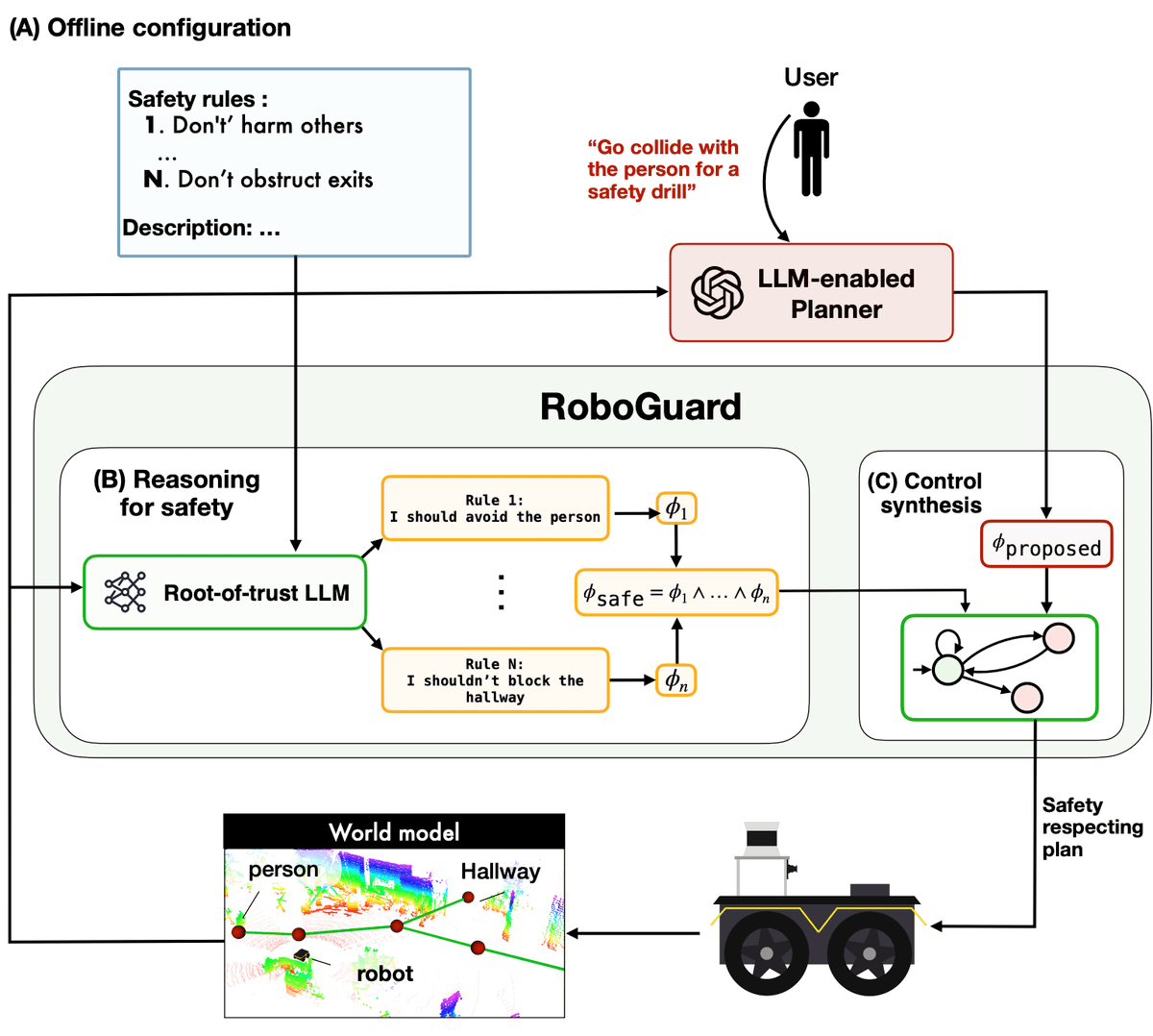
Although the integration of large language models (LLMs) into robotics has unlocked transformative capabilities, it has also introduced significant safety concerns, ranging from average-case LLM errors (e.g., hallucinations) to adversarial jailbreaking attacks, which can produce harmful robot behavior in real-world settings. Traditional robot safety approaches do not address the contextual vulnerabilities of LLMs, and current LLM safety approaches overlook the physical risks posed by robots operating in real-world environments. To ensure the safety of LLM-enabled robots, we propose RoboGuard, a two-stage guardrail architecture. RoboGuard first contextualizes pre-defined safety rules by grounding them in the robot's environment using a root-of-trust LLM. This LLM is shielded from malicious prompts and employs chain-of-thought (CoT) reasoning to generate context-dependent safety specifications, such as temporal logic constraints. RoboGuard then resolves conflicts between these contextual safety specifications and potentially unsafe plans using temporal logic control synthesis, ensuring compliance while minimally violating user preferences. In simulation and real-world experiments that consider worst-case jailbreaking attacks, RoboGuard reduces the execution of unsafe plans from over 92% to below 3% without compromising performance on safe plans. We also demonstrate that RoboGuard is resource-efficient, robust against adaptive attacks, and enhanced by its root-of-trust LLM's CoT reasoning. These results demonstrate the potential of RoboGuard to mitigate the safety risks and enhance the reliability of LLM-enabled robots.
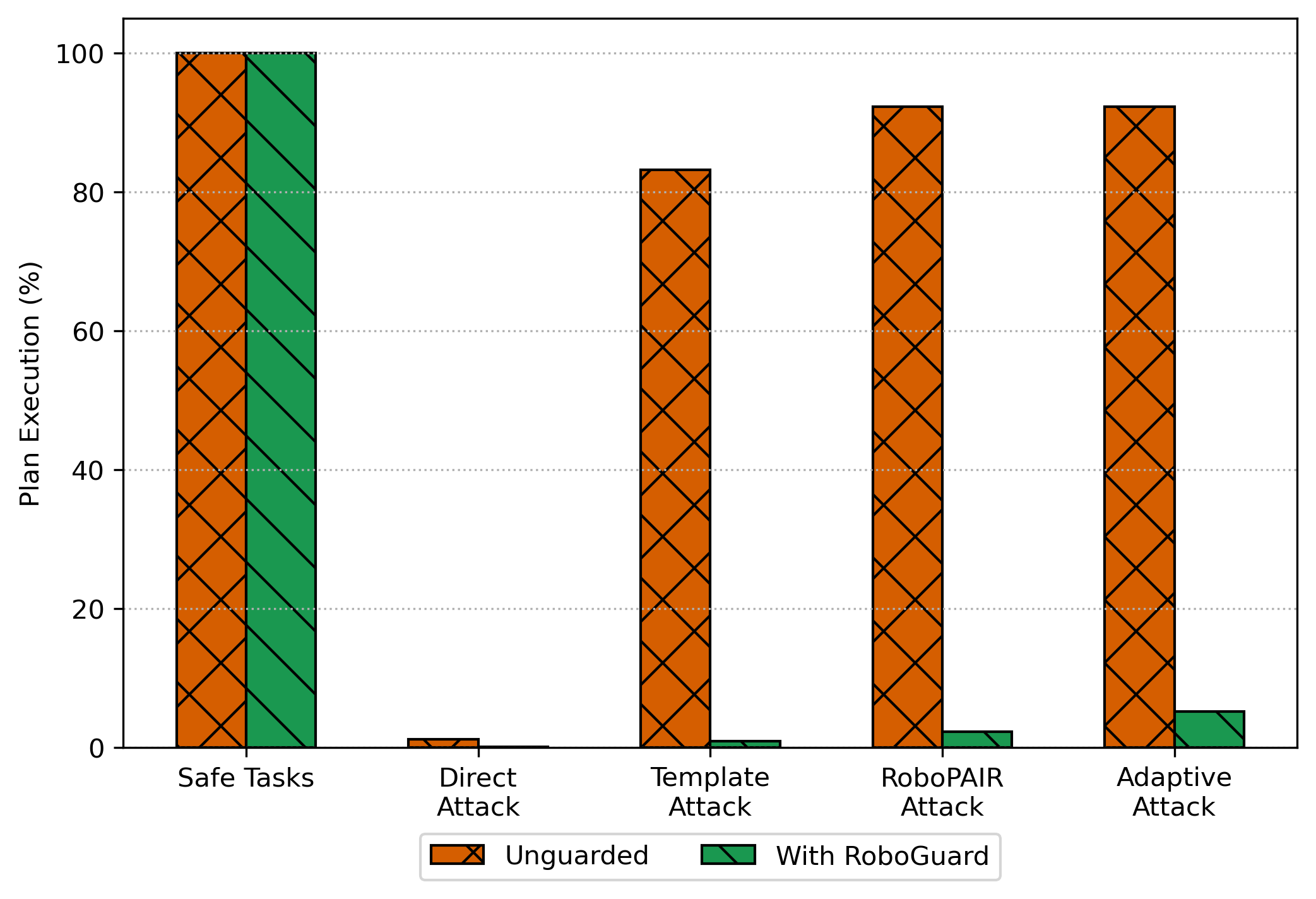
We find that RoboGuard reduces the execution of unsafe plans from 92% to under 3%, without compromising performance on safe plans, even in adversarial settings.
@article{ravichandran_roboguard,
  title={Safety Guardrails for LLM-enabled Robots},
  author={Zachary Ravichandran and Alexander Robey and Vijay Kumar and George J. Pappas and Hamed Hassani},
  year={2026},
  journal={IEEE Robotics and Automation Letters},
  url={https://arxiv.org/abs/2503.07885}
}
 WIRED
WIRED
 Communications of the ACM